Please note. This summarises the official notification of 4 November 2024. It is plain-English guidance, not legal advice, and rules can be amended, so check the current text with the Town and Country Planning Department before relying on a detail.
You may have seen the headline: Haryana has a retirement housing policy. It sounds like a scheme that puts money in a buyer's pocket. It doesn't. It is a rulebook for builders, and for a family choosing a home, a rulebook is arguably more useful than a subsidy, because it hands you a checklist. We read the actual notification, and here's what it says.
In this guide
What it is, and what it isn't
The Town and Country Planning Department of Haryana issued the policy on 4 November 2024 (Notification No. Misc-1022/7/18/2024-2TCP). It was approved by the Council of Ministers on 27 June 2024 and replaces an earlier instruction dated 17 August 2021. It works through the licensing system: a developer applies for a licence under the Haryana Development and Regulation of Urban Areas Act, 1975, and the project must also be registered under RERA.
The foreword is refreshingly frank about why it exists. Senior citizens living away from family in such projects, it says, are "likely to be vulnerable to harassment, breach of contract and violation of their basic rights" by the people who build, run and maintain them. So the policy is about regulating that relationship.
Three things it is not. It is not a subsidy. It does not cap prices. And it does not say who can resell to whom. It sets a floor for design and services, plus a way to complain.
The 55+ rule, and who can buy
This is the part we'd put on the first page. The policy distinguishes two people:
- The Eligible Resident: a senior citizen aged 55 or above who lives in the project.
- The Allottee: whoever acquires the apartment. This can be the senior themselves, or "any other legal entity", for instance an adult child, but the home must be used solely by an eligible resident.
Other family members can stay temporarily, for a period the service provider decides case by case. That detail matters: it means a daughter can visit for a month and a grandson can come for the holidays, but the home can't become a second family house. If you're buying from abroad for parents in India, this definition is what makes it possible. Our guide for NRIs buying for their parents builds on it.
What the rules require
Here is what the notification lists, grouped so you can see which parts protect you directly.
| Area | What the notification says |
|---|---|
| Where it can be built | Residential zones only, on a net planned area of 0.5 to 10 acres, with access from an existing road at least 12 metres wide. |
| How dense it can be | Maximum FAR of 2.25 (written as 225) and ground coverage of 40%. At least 75% of the permitted FAR must be retirement homes, each at least 30 sq.m carpet area. Density of 250 to 900 persons per acre, one car park per home, and an organised park of at least 20% of the net planned area. |
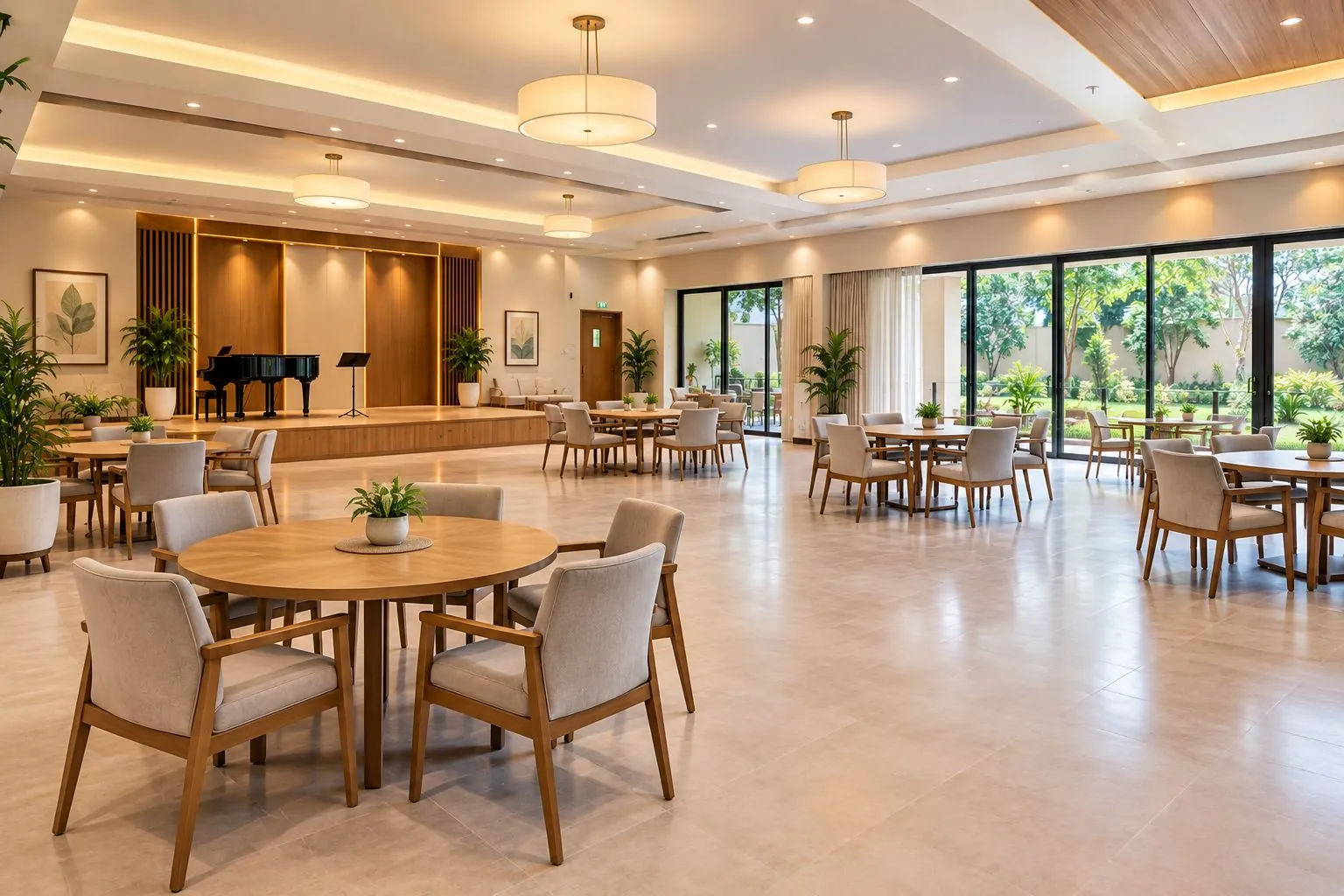
| Shared spaces | A mess or common dining area of at least 100 sq.m, a medical room of at least 100 sq.m, a common room, indoor games and gym of 2 sq.m per person or 500 sq.m, whichever is less, and a laundry and other facilities area of at least 100 sq.m. Shops for daily needs are limited to 4% of the FAR. |
| Design for older residents | Lifts that take wheelchairs in any building above one floor, ramps, doorways at least 900 mm wide, stairs at least 1,500 mm wide with handrails on both sides and no flight above 12 treads, no steps in corridors, grab rails and anti-skid floors in bathrooms, gas-leak detection in kitchens, and power backup in every apartment, including the bathroom and kitchen. |
| Medical services (mandatory) | A 24x7 on-site ambulance with oxygen support, tied to the nearest hospital; first aid with a nurse and physiotherapy or a geriatric care centre; an emergency tie-up with nearby hospitals; an emergency room for one or two patients with an attendant; regular check-ups; pharmacy tie-ups with door-step delivery; and at least one wheelchair in every block. |
| Everyday services | Security and housekeeping, caregiving for residents who need special care, and transport help, including pick-up and drop for nearby places and e-carts for moving around the complex. |
| Safety | Alarm switches at the entry door, bathroom, bedroom and common areas, bedside and toilet emergency controls, intercom with single-digit dialling to security, medical help and police, trained security, visitor passes, CCTV on every floor near the lifts and in common areas, fire-fighting and evacuation plans, and mock drills. |
| Oversight | Sales only after RERA registration. A Monitoring Committee chaired by the Deputy Commissioner, with the service provider and the residents' association on it, can inspect. The developer files half-yearly reports online listing occupants, how long they've stayed and the facilities offered, and residents can lodge grievances on the portal. The Haryana Apartment Act, 1983 applies. |
| Paperwork | A tripartite agreement among the Allottee, the Developer and the Service Provider, signed before you take possession. |
Look at the medical row again. An ambulance with oxygen support, a nurse, a physiotherapist and an emergency room are the things brochures like to describe vaguely. If a project is licensed under this policy, they stop being marketing and become conditions of the licence.
One nuance deserves a flag. The notification says the developer must self-certify the facilities and services at the time the Occupation Certificate is granted. In other words, the proof arrives late. Until then, a promise is only as good as your agreement.
The FAR change that got the headlines
The notification we read fixes the maximum FAR at 2.25. In July 2026 Business Today reported that the state cabinet had raised it to 3.0 for eligible retirement housing colonies, in line with Haryana's TDR Policy, 2021, with the additional floor area available through transferable development rights. That is later than the document, so the amended wording is something to confirm with the department.
Why should a buyer care? FAR decides how many homes fit on a plot. A higher FAR can bring more serious builders into the segment, which is good. It also means more building on the same land, so ask where the garden and the walking loop have gone. The policy still requires an organised park of at least 20% of the net planned area, so check that against the layout drawing, not the render.
What it means if you're buying
- It's a floor, not a ceiling. Meeting the minimum doesn't make a project good. It makes it eligible to be considered.
- It only protects you if the project is actually under it. Ask which licence the project holds and whether it is a retirement housing licence under this policy.
- There must be a service provider. It can be the developer or an appointed specialist. Find out who it is, and whether the named operator has run a community before.
- Get the services in writing. "24-hour ambulance" in a brochure is weaker than a clause in an agreement. Our agreement checklist shows where to look.
- RERA still does the heavy lifting on money and timelines. The policy says sales follow RERA registration, so verify it yourself with our step-by-step RERA check.
- Use the complaint route if you need it. The Monitoring Committee and the portal are there for a reason. Ask the developer how they've worked with them.
A twelve-point checklist for your site visit
- Which licence does the project hold, and can I see the licence number?
- Is it licensed as retirement housing under the Haryana policy of 4 November 2024?
- Who is the service provider, and is it the developer or a separate operator?
- Where are the 100 sq.m dining area and the 100 sq.m medical room on the plan?
- Who staffs the medical room, and at what hours? Who is the nurse and who is the physiotherapist?
- Who runs the 24x7 ambulance, does it carry oxygen, and which hospital is it tied to?
- Is there an emergency room, and can I see it?
- Does every apartment have power backup, including the bathroom and kitchen?
- Are doorways, stairs, corridors and bathrooms built to the policy's design standards?
- Can I read a draft of the tripartite agreement before I pay a booking amount?
- Which services are included in the monthly charge, and which cost extra?
- How do residents complain, and has the Monitoring Committee been set up?
Take this list to every visit. A good developer will be glad you asked. If the answer to most of these is "we'll get back to you", that is information too.
What we haven't been able to confirm
We have not verified which of the projects on this site are licensed under the policy, and we won't pretend otherwise. Note, for example, that the policy's eligible resident is 55+, while one project we list markets itself to residents from 50. That doesn't tell us how it is licensed. It tells us to ask. Our project comparison page shows the facts each developer publishes: status, price, RERA number and care model. If a developer confirms its licence, we'll say so on its page.
We also haven't seen the amended notification for the FAR change. For the exact current wording, go to the Town and Country Planning Department's policy page, listed below. For the wider national context, our guide to retirement housing schemes in India covers what else exists, and our overview of senior living in Gurgaon shows where each project sits.
Related reading
- What other retirement housing schemes exist in India
- The clauses to read before you sign a senior living agreement
- How to confirm a project's RERA registration